

 Sign In

Synopsis
Bandwagoning is a type of alignment strategy applied by states towards others in international relations. According to Stephen Walt, bandwagoning “refers to alignment with the source of danger.” The logic behind bandwagoning is this: “[S]tates are attracted to strength. The more powerful the state and the more clearly this power is demonstrated, the more likely others are to ally with it. By contrast, a decline in a state’s relative position will lead its allies to opt for neutrality at best or to defect to the other side at worst” (Walt 1987).
According to Walt, states can have two motives to bandwagon:
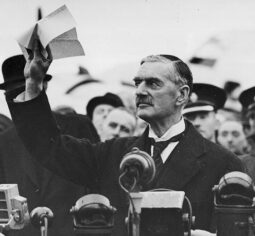
1) Bandwagoning as a form of appeasement: aligning with a potentially dangerous state “to avoiding an attack by diverting it elsewhere.” As such, it is the opposite of balancing, and occupies a place in Walt’s balance-of-threat theory.
2) A “state may align with the dominant side in wartime in order to share the spoils of victory.”
On the part of Joseph Stalin, the 1939 Nazi-Soviet Non-Aggression Treaty (or Molotov-Ribbentrop Pact) involved both motivations. One was to buy time in the hope that Hitler would move westward and leave the Soviet Union alone, and one to share the fruits of common victory. Through their simultaneous attacks from September 1939 onwards, as agreed in the Pact, Hitler took most Poland, while Stalin conquered the Baltic states, the rest of Poland (currently parts of Lithuania and Ukraine) and Bessarabia (including present-day Moldova).
Randall Schweller emphasizes the opportunistic motive for bandwagoning, which therefore has more often occurred in history than Walt and other balance-of-threat or balance-of-power theorists believe. Examples are revisionist states such as Italy, Hungary and Japan joining Nazi Germany in World War II. Sometimes states bandwagon with great power because they believe it represents ‘the wave of the future.’ Examples are developing countries allying with the Soviet Union in the 1960-1970s. “Other examples of supporting-the-winner bandwagoning include the near-unanimous enthusiasm with which the southern German states joined Prussia after its defeat of France in 1871 [to form the German Empire], and the Austrians' embrace of the Anschluss with Germany in 1938” (Schweller 1994).
Carlos Escudé’s ‘peripheral realism’ has described – and prescribed – bandwagoning by Latin American countries towards the United States for the sake of protection and prosperity, rather than seeking maximum strategic autonomy, let alone confrontation or joining anti-US balancing coalitions (Schenoni and Escudé 2016).
Bibliography
Topics
Theories

See More