

 Sign In

Synopsis
Driven by the increase of international interaction at state and society level after the Second World War, Karl Deutsch presented quantitative studies of the interactions in the fields of trade, international communication (telecommunication, mail, television, etc.), migration, tourism, educational, cultural and scientific exchange, etc. between countries the US and Western Europe (Deutsch, 1957).
From his positivist, behavioralist vantage point, he arrived at the constructivist insight that these societies had become integrated as a trans-national political community and adopted a common identity, i.e. a new reality that transcends the logic of the inter-national states system. Relying on this common identity, disputes are settled peacefully and war has become unthinkable. Deutsch baptized such zones of peace as ‘security communities.’
Deutsch draws a distinction between ‘amalgamated’ and ‘pluralistic’ security communities. The former came about as “the formal merger of two or more previously independent units into a single larger unit, with some type of common government after amalgamation.” The latter retain “the legal independence of separate governments” (Deutsch, 1957, p. 6).
Barnett and Adler argue that, despite Deutsch’s positivist leanings, the notion of security communities is essentially sociological and constructivist. Beyond the distribution of material resources and quantifiable interactions, what really matters is the ensuing transnational identity formation and sense of ‘we-ness’, which holds promises for lasting peace. Therefore the approach requires more qualitative and interpretative study (Barnett & Adler, 1998).
Deutsch’ work did not receive much follow-up in later decades. The much less sociological neoliberal institutionalism gained traction in the 1960s and 1970s, focusing on how institutions were formed to coordinate and stabilize cooperation among states on material interests. This was followed by a new upsurge of realism – in the form of Waltzian structural realism – due to a new escalation in the Cold War from the mid-1970s on. After the Cold War – in the context of renewed optimism about peace and the breakthrough of constructivism as a new strand in international relations theory – the notion of security communities was rediscovered. Barnett and Adler’s 1998 volume marked this momentum (1998).
Recent generations have felt that war among North American and Western European countries has become unimaginable indeed. The French and German armies no longer have strategic plans against each other, after a few hundreds of years of rivalry and horrific war. If a security community is possible in the EU and even the North Atlantic area, why would it not be possible everywhere, including in regions that are still marked by wars or deep distrust and fierce competition, such as the Middle East or East Asia? A related question is whether the world can ever become a global security community.
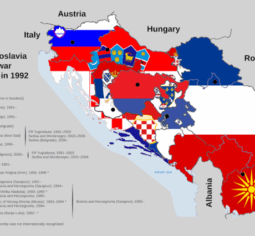
However, research and theorizing is also needed about the durability of a security community, and how it might fall apart. Think of the way sovereign states such as the US in the 1860s or Yugoslavia in the 1990s (which eventually broke up) plunged into civil war. Despite Brexit, the EU plus the UK still constitute a solid security community, but theoretically, a return to antagonistic nation-states cannot entirely be excluded. Due the rise of ultranationalism, xenophobia and Euroscepticism we are reminded of how fragile a pan-European identity is.
Bibliography
Theories
See More