

 Sign In
Synopsis
Basic assumptions
As a comprehensive historical materialist theory on the relationship between the capitalist economic system, politics and society, Marxism offers a rich perspective for the analysis of international politics. For Marxist IR scholars, the capitalist world economy provides the essential background to international developments. They tend to situate causes for major international phenomena in the material economic ‘infrastructure’, which comprises the production factors (land/nature, labor, capital), the material interests of their owners, and the relations between them. The struggle between the capitalist and working classes with their respective interests is a key driver of international politics. As such, classes are the relevant actors, whereas states and international organizations are rather institutional arrangements that are instrumentalized by classes, or merely sites for class struggle.
Marxists maintain that the capitalist class – i.e. the owners of capital – will never stop pursuing capital accumulation through profit maximization. Companies need additional financial capital – as surplus value deducted from the theoretical fair remuneration of labor – to reinvest it in productive capital (buildings, machines, new technology to enhance productivity) in order to remain competitive and survive. Profits are also what shareholders expect from the managers; without profits either the management must go, or the shareholders will leave. For the sake of capital accumulation, capitalists are interested to influence politics, for which they use their financial resources. Their power is wielded in several ways:
• Governments are dependent on private bankers for loans.
• Industrial capital has influence over governments because they can decide how much will be invested in the country, which then determines the level of employment and tax capacity.
• Private industrial companies are often indispensable suppliers of arms.
• In a globalized economy, capital can exert extra pressure on governments by moving, or threatening to move, to countries with lower wages, lower taxes, or lower labor and environmental standards.
• Given their central place in powerful elite networks, capitalists have huge influence on the recruitment of politicians and ministers. Part of their influence is due to the fact that many people simply admire and aspire wealth and success.
• The ‘revolving door’: before office, many government officials had a senior job in the private sector, and bring with them certain interests or ideological positions; after office, government officials can often enter into lucrative posts in the private sector, a prospect that already influences their work during public office.
• Funding political parties and civil society organizations.
• Owning mass media.
Hence, capitalist have various ways to instrumentalize the state. That is why Marxist scholars have the reflex to look first for capitalist class interests to explain phenomena such as conflicts and wars, or the design and decisions of intergovernmental organizations. This is not always to rule out other explanations, but rather to offer additional insights often overlooked by scholars from other traditions.
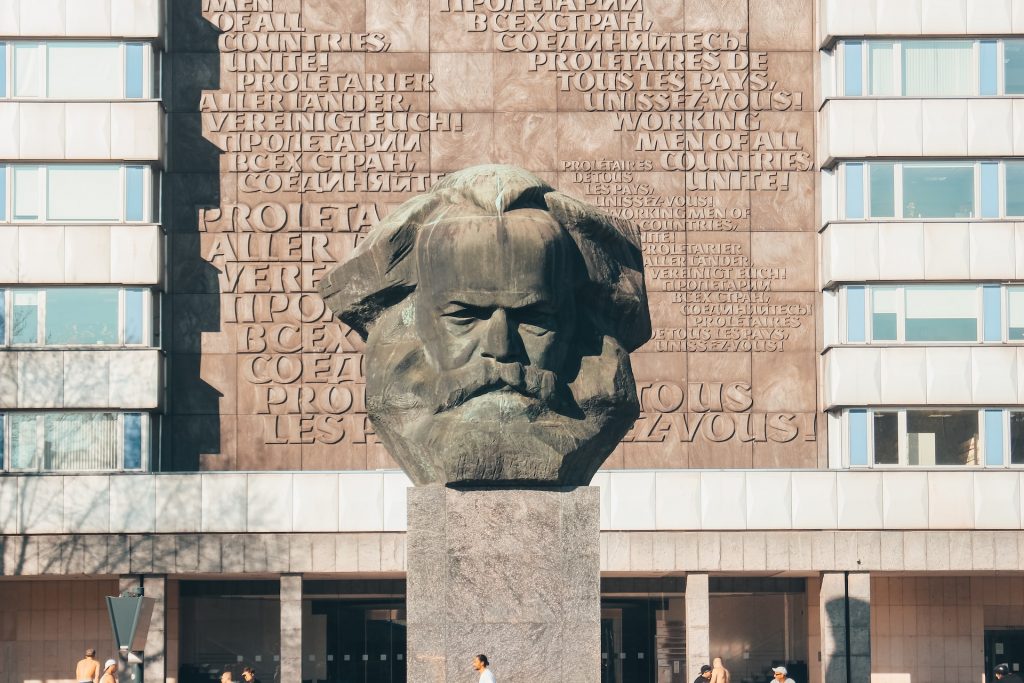
Karl Marx (1818-1883) himself was not a great theorist of international relations. He rightly foresaw that capitalism would continue to expand geographically, eventually to encompass the entire globe. Expansion would also take the form of absorbing more and more goods and services into the capitalist market economy. Nowadays, we witness how items such as water, knowledge or public transportation are increasingly submitted to privatization and profit-seeking indeed – i.e. the process of commodification. In his dialectical, teleological vision on the class struggle between capital and labor, he believed that the working class – or proletariat – would be more successful in organizing itself transnationally into a cosmopolitan class, whereas the capitalists – or bourgeoisie – would stick to a rather national scale. However, since the late 20th century we see much more indications of robust transnational organization of capital rather than labor (Linklater, 2009; Teschke, 2008). Now we do have giant global companies with their global supply chains, but are still waiting for the first regional (e.g. at EU level), let alone global workers’ strikes.
Marxism offers a rich and multifaceted framework for understanding global politics, rooted in its analysis of class relations, capitalism, and structural power. While classical Marxism provides the foundation, several important substrands deepen and diversify its analytical reach, including theories of imperialism, neo-Gramscian approaches to hegemony, and world-systems analysis.
Bibliography
Topics
Theories
What to learn?
Know how to configure Wordpress for best results Understand plugins & themes and how to find/install them Protect their Wordpress website from hackers and spammers Create a static homepage useful for most websites, or a blog like homepage useful for bloggers. Create an affiliate site for passive, recurring income Create a Responsive Website that looks good on any browserInstructor
See More