

 Sign In
Synopsis
This concept was coined by Nobel laureate atmospheric chemist Paul Crutzen and marine specialist Eugene F. Stoermer in a scientific newsletter. Later in 2002, the concept was further elaborated in Nature. “For the past three centuries, the effects of humans on the global environment have escalated. Because of these anthropogenic emissions of carbon dioxide, global climate may depart significantly from natural behaviour for many millennia to come. It seems appropriate to assign the term ‘Anthropocene’ to the present, in many ways human-dominated, geological epoch, supplementing the Holocene – the warm period of the past 10-12 millennia. The Anthropocene could be said to have started in the latter part of the eighteenth century when analyses of air trapped in polar ice showed the beginning of growing global concentrations of carbon dioxide and methane. This date also happens to coincide with James Watt’s design of the steam engine” (Crutzen 2002).
The Geological Society of London recognised Crutzen’s definition: “Sufficient evidence has emerged of stratigraphically significant change (both elapsed and imminent) for recognition of the Anthropocene— currently a vivid yet informal metaphor of global environmental change—as a new geological epoch to be considered for formalization by international discussion.”
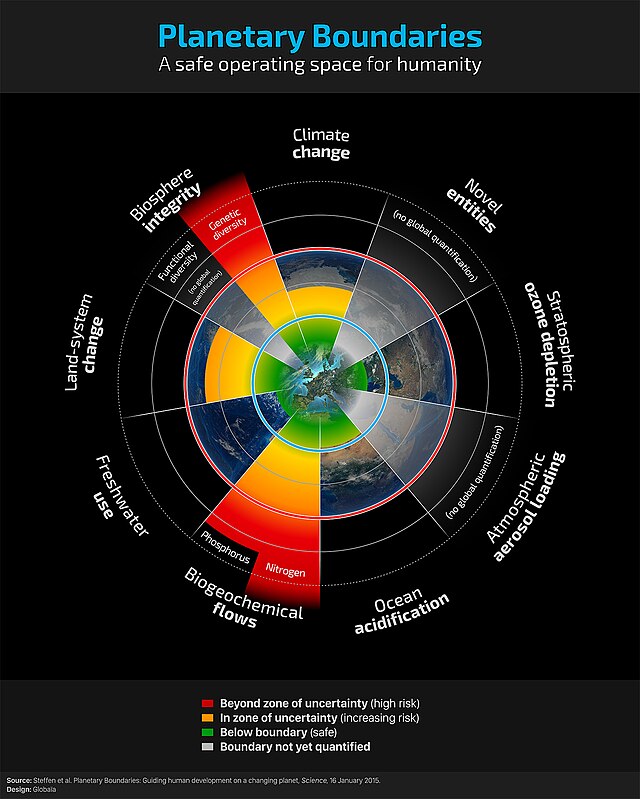
Foster et. al, tell us that “[…] the current course on which the world is headed could be described not so much as the appearance of a stable new geological epoch (the Anthropocene), an end-Holocene, or more ominously, end-Quarternary, terminal event, which is a way of referring to the mass extinctions that often separate geological eras. Planetary boundaries and tipping points, leading to the irreversible degradation of the conditions of life on Earth, may soon be reached, science tells us, with a continuation of today’s business as usual. The Anthropocene may be the shortest flicker in geological time, soon snuffled out” (Foster et. al. 2010).
Malm and Hornborg provide a critique of the term Anthropocene, pointing out the scientists are crossing the line between science and social matters, and so the Anthropocene cannot properly explain the complexity of the latter. “The Anthropocene narrative could here be seen as an illogical and ultimately self-defeating foray of the natural science community –responsible for the original discovery of climate change – into the domain of human affairs. Geologists, meteorologists and their colleague are not necessarily well-equipped to study the sort of things that take place between humans (and perforce between them and the rest of nature), the composition of a rock or the pattern of a jet stream being rather a different from such phenomena as world-views, property and power. […] Against this background, ‘the Anthropocene’ resembles an attempt to conceptually traverse the gap between the natural and the social…” (Malm and Hornborg (2014).
Chakrabarty is more conciliatory in relation to scientists but does put power and capital as factors to be taken into account when the term Anthropocene and discussions around it take place. This is relevant for those involved in the study of IR. This link between the Anthropocene and power is key to understanding how the Anthropocene can fit in the realm of IR theories. “[…] Climate change, refracted through global capital, will no doubt accentuate the logic of inequality that runs through the rule of capital; some people will no doubt gain temporarily at the expense of others. But the whole crisis cannot be reduced to a story of capitalism. Unlike in the crises of capitalism, there are no lifeboats here for the rich and the privileged (witness the drought in Australia or recent fires in the wealthy neighbourhoods of California). The anxiety global warming gives rise to, is reminiscent of the days when many feared a global nuclear war. But there is a very important difference. A nuclear war would have been a conscious decision on the part of the powers that be. Climate change is an unintended consequence of human actions and shows, only through scientific analysis, the effects of our actions as a species. […]” (Chakrabarty 2009).
The Anthropocene as a new epoch brings into question the traditional modes of conceptualising International Relations. We believe that it does this by forcing students and practitioners of International Relations to think through how the discipline works as a set of ideas and practices, in fact, as a way of understanding the nature of problems and policymaking per se. […] (Chandler et al., 2021).
Burke et al., argue that “International Relations, as both a system of knowledge and institutional practice, is undone by the reality of the planet. […] If the biosphere is collapsing, and if International Relations has always presented itself as that discourse which takes the global as its point of departure, how is it that we – IR’s scholars, diplomats and leaders – have not engaged with the planetary real? We contend that International Relations has failed because the planet does not match and cannot be clearly seen by its institutional and disciplinary frameworks. Institutionally and legally, it is organised around a managed anarchy of nation-states, not the collective human interaction with the biosphere. Intellectually, the IR discipline is organised sociologically around established paradigms and research programmes likewise focused on states and the forms of international organisation they will tolerate; it is not organised to value or create the conceptual and analytical changes that are needed. […] The Anthropocene represents a new kind of power – ‘social nature’ – that is now turning on us. This power challenges our categories and methodologies. It demands we find accomplices in our discipline and beyond it. It demands a new global political project: to end human-caused extinctions, prevent dangerous climate change, save the oceans, support vulnerable multi-species populations, and restore social justice” (Burke et al. 2016).
Bibliography
Topics
About Course
This concept was coined by Nobel laureate atmospheric chemist Paul Crutzen and marine specialist Eugene F. Stoermer in a scientific newsletter. Later in 2002, the concept was further elaborated in Nature. “For the past three centuries, the effects of humans on the global environment have escalated. Because of these anthropogenic emissions of carbon dioxide, global climate may depart significantly from natural behaviour for many millennia to come. It seems appropriate to assign the term ‘Anthropocene’ to the present, in many ways human-dominated, geological epoch, supplementing the Holocene – the warm period of the past 10-12 millennia. The Anthropocene could be said to have started in the latter part of the eighteenth century when analyses of air trapped in polar ice showed the beginning of growing global concentrations of carbon dioxide and methane. This date also happens to coincide with James Watt’s design of the steam engine” (Crutzen 2002). The Geological Society of London recognised Crutzen’s definition: “Sufficient evidence has emerged of stratigraphically significant change (both elapsed and imminent) for recognition of the Anthropocene— currently a vivid yet informal metaphor of global environmental change—as a new geological epoch to be considered for formalization by international discussion.” Foster et. al, tell us that “[…] the current course on which the world is headed could be described not so much as the appearance of a stable new geological epoch (the Anthropocene), an end-Holocene, or more ominously, end-Quarternary, terminal event, which is a way of referring to the mass extinctions that often separate geological eras. Planetary boundaries and tipping points, leading to the irreversible degradation of the conditions of life on Earth, may soon be reached, science tells us, with a continuation of today’s business as usual. The Anthropocene may be the shortest flicker in geological time, soon snuffled out” (Foster et. al. 2010). Malm and Hornborg provide a critique of the term Anthropocene, pointing out the scientists are crossing the line between science and social matters, and so the Anthropocene cannot properly explain the complexity of the latter. “The Anthropocene narrative could here be seen as an illogical and ultimately self-defeating foray of the natural science community –responsible for the original discovery of climate change – into the domain of human affairs. Geologists, meteorologists and their colleague are not necessarily well-equipped to study the sort of things that take place between humans (and perforce between them and the rest of nature), the composition of a rock or the pattern of a jet stream being rather a different from such phenomena as world-views, property and power. […] Against this background, ‘the Anthropocene’ resembles an attempt to conceptually traverse the gap between the natural and the social…” (Malm and Hornborg (2014) Chakrabarty is more conciliatory in relation to scientists but does put power and capital as factors to be taken into account when the term Anthropocene and discussions around it take place. This is relevant for those involved in the study of IR. This link between the Anthropocene and power is key to understanding how the Anthropocene can fit in the realm of IR theories. “[…] Climate change, refracted through global capital, will no doubt accentuate the logic of inequality that runs through the rule of capital; some people will no doubt gain temporarily at the expense of others. But the whole crisis cannot be reduced to a story of capitalism. Unlike in the crises of capitalism, there are no lifeboats here for the rich and the privileged (witness the drought in Australia or recent fires in the wealthy neighbourhoods of California). The anxiety global warming gives rise to, is reminiscent of the days when many feared a global nuclear war. But there is a very important difference. A nuclear war would have been a conscious decision on the part of the powers that be. Climate change is an unintended consequence of human actions and shows, only through scientific analysis, the effects of our actions as a species. […]” (Chakrabarty 2009). The Anthropocene as a new epoch brings into question the traditional modes of conceptualising International Relations. We believe that it does this by forcing students and practitioners of International Relations to think through how the discipline works as a set of ideas and practices, in fact, as a way of understanding the nature of problems and policymaking per se. […] (Chandler et al., 2021). Burke et al., argue that “International Relations, as both a system of knowledge and institutional practice, is undone by the reality of the planet. […] If the biosphere is collapsing, and if International Relations has always presented itself as that discourse which takes the global as its point of departure, how is it that we – IR’s scholars, diplomats and leaders – have not engaged with the planetary real? We contend that International Relations has failed because the planet does not match and cannot be clearly seen by its institutional and disciplinary frameworks. Institutionally and legally, it is organised around a managed anarchy of nation-states, not the collective human interaction with the biosphere. Intellectually, the IR discipline is organised sociologically around established paradigms and research programmes likewise focused on states and the forms of international organisation they will tolerate; it is not organised to value or create the conceptual and analytical changes that are needed. […] The Anthropocene represents a new kind of power – ‘social nature’ – that is now turning on us. This power challenges our categories and methodologies. It demands we find accomplices in our discipline and beyond it. It demands a new global political project: to end human-caused extinctions, prevent dangerous climate change, save the oceans, support vulnerable multi-species populations, and restore social justice” (Burke et al. 2016).
What to learn?
Instructor